In the ever-evolving landscape of artificial intelligence, the rise of transformer models has been nothing short of revolutionary. These models, particularly the Action Transformer Model, have taken the AI world by storm, pushing the boundaries of what machines can understand and execute. This article delves into the essence of the Action Transformer Model, its significance, and its wide-ranging applications.
A Transformer Model Primer
Before we dive into the specifics of Action Transformer Models, let’s revisit the foundation upon which they are built – the transformer model. Developed by Vaswani et al. in 2017, the transformer architecture was a game-changer for natural language processing. It significantly outperformed previous methods and laid the groundwork for more advanced AI systems.
The transformer model is essentially a neural network architecture that processes input data in parallel, as opposed to sequentially. It relies on attention mechanisms to weigh the importance of different parts of the input data, enabling it to capture complex relationships within the data.
Enter the Action Transformer Model
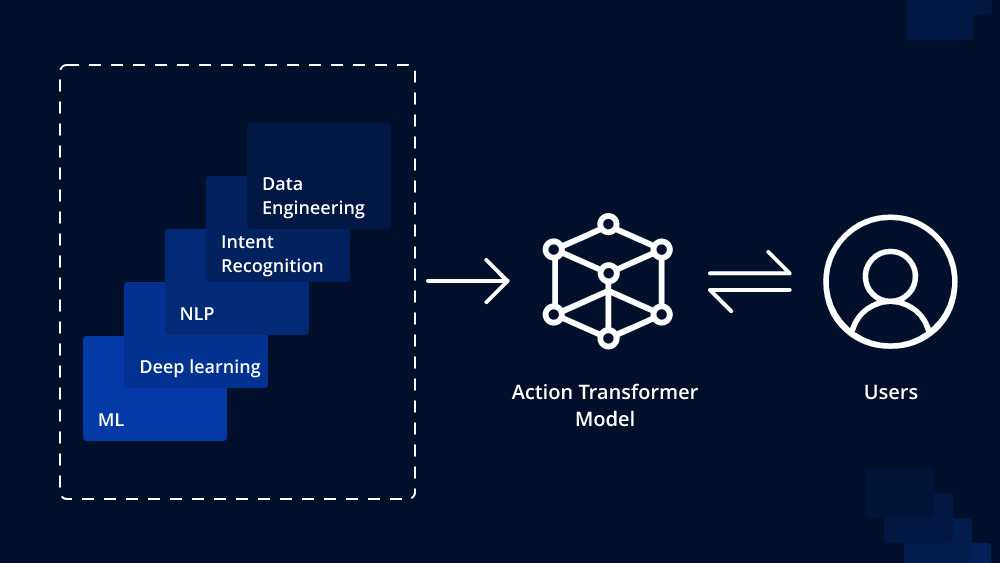
The Action Transformer Model takes the transformer concept to a new level. It doesn’t merely understand and process data; it’s designed to comprehend actions. This advancement marks a pivotal moment in the development of AI systems, as it bridges the gap between language understanding and action execution.
Key Components of the Action Transformer Model
- Action Embedding: At the heart of the Action Transformer Model is the action embedding. Just as a transformer model embeds words or tokens, the Action Transformer embeds actions. This embedding provides a structured representation of actions, making it easier for the model to process and understand them.
- Temporal Modeling: Understanding actions often involves comprehending their temporal relationships. The Action Transformer incorporates temporal modeling, allowing it to consider the order and timing of actions, which is crucial for accurate action prediction and execution.
- Attention Mechanisms: Like the original transformer, the Action Transformer relies heavily on attention mechanisms. However, here, attention is not just about words or tokens but also about actions. This enables the model to attend to relevant actions and their contexts when making predictions.
- Multi-Modal Input: The Action Transformer is not limited to textual or numerical data. It can process multi-modal data, which includes text, images, and videos, making it incredibly versatile in understanding a wide array of actions.
Applications of the Action Transformer Model
The versatility of the Action Transformer Model opens up a plethora of applications across various domains. Here are some notable examples:
1. Video Analysis
The Action Transformer Model can be employed in video analysis tasks, such as action recognition and anticipation. It can understand the sequence of actions in a video, making it valuable in surveillance, sports analysis, and even entertainment.
2. Autonomous Vehicles
Self-driving cars heavily rely on understanding and predicting actions in the surrounding environment. The Action Transformer Model can play a vital role in enhancing the decision-making process of autonomous vehicles by analyzing the actions of other vehicles, pedestrians, and objects.
3. Healthcare
In healthcare, the Action Transformer can assist in monitoring and predicting patient actions, helping healthcare providers make informed decisions. It can be particularly useful for tracking patient movements and adherence to treatment plans.
4. Robotics
Robots equipped with Action Transformer Models can better understand and execute human commands. This has implications in manufacturing, logistics, and even domestic settings where robots perform various tasks.
5. Natural Language Understanding
The Action Transformer Model can be integrated into chatbots and virtual assistants, allowing them to not only understand user requests but also anticipate and execute actions accordingly. This takes conversational AI to a new level of utility.
Challenges and Future Directions
Despite the tremendous potential of Action Transformer Models, there are challenges to address. One significant challenge is the need for large-scale, labeled action datasets for training. Additionally, handling long and complex sequences of actions can be computationally intensive.
Looking ahead, researchers are exploring ways to make Action Transformers more efficient and scalable. This includes optimizing architecture, pre-training strategies, and fine-tuning techniques. The integration of reinforcement learning to enhance action execution is another exciting avenue of research.
Conclusion
The Action Transformer Model represents a quantum leap in AI understanding and execution. Its ability to comprehend and predict actions across various domains promises to reshape industries and push the boundaries of what AI can achieve. From video analysis to healthcare and robotics, the applications are limitless.
As the field of artificial intelligence continues to evolve, Action Transformer Models will undoubtedly play a pivotal role in advancing our capabilities to understand and interact with the world around us. While challenges remain, the potential for this technology is nothing short of groundbreaking, promising a future where machines truly understand and respond to human actions.
 Archie Evans Business