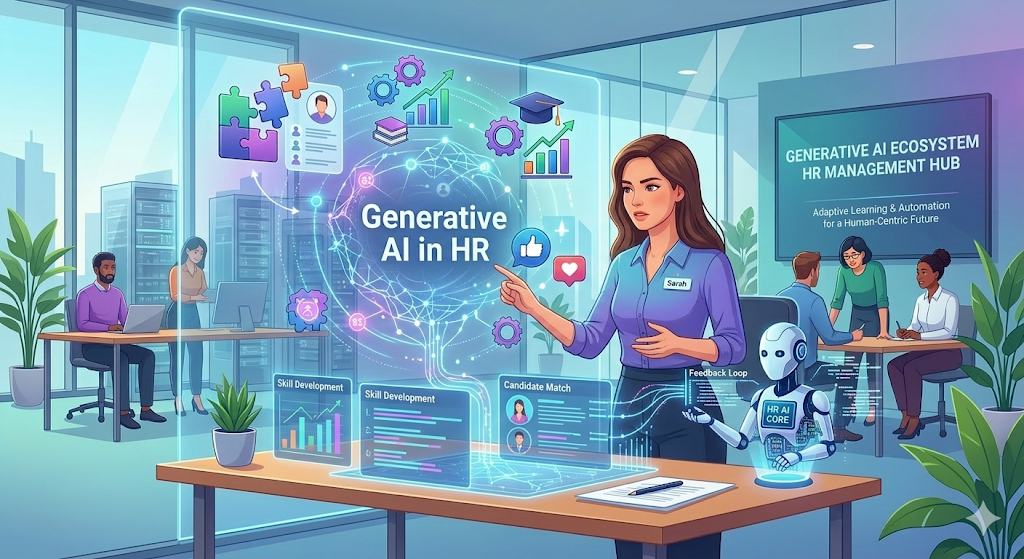
The role of human resource management (HRM) is evolving rapidly as organizations adapt to digital transformation, changing workforce expectations, and increased competition for skilled talent. Today, HR leaders, HR professionals, and HR departments are expected to manage complex workforce challenges while also driving innovation, productivity, and employee engagement. This shift has accelerated the adoption of AI in HR and generative AI in human resources, enabling organizations to automate repetitive HR tasks, generate workforce insights, and enhance employee communication. By integrating artificial intelligence in HR, companies can modernize HR operations, improve talent management, and optimize workforce management throughout the employee lifecycle, allowing HR teams to focus on strategic initiatives that support long-term organizational growth.
The Growing Role of AI in HR Transformation
The adoption of AI in human resources is expanding across industries as organizations recognize its ability to transform HR management and improve HR efficiency. Modern HR departments handle large volumes of employee data, HR documentation, training content, and communication materials, which can be time-consuming to manage manually. With AI for HR, organizations can automate the creation and management of HR documents, generate insights from workforce data, and streamline administrative tasks. Generative AI in HR can create job descriptions, summarize employee feedback, draft HR policies, and provide learning recommendations, helping HR teams operate more efficiently while improving decision-making across key HR functions such as talent acquisition, workforce planning, and employee engagement.
Key Use Cases of AI in HR
Recruitment and Talent Acquisition
One of the most widely adopted applications of AI in HR is recruitment and talent acquisition, where HR teams must evaluate large numbers of candidates quickly and efficiently. AI-powered recruitment tools can screen resumes, analyze candidate profiles, and match applicants with job requirements based on skills, experience, and qualifications. These capabilities help HR professionals identify suitable candidates faster, reduce hiring time, and improve recruitment accuracy. Additionally, AI for HR management can automate interview scheduling, monitor candidate engagement, and generate recruitment analytics, enabling organizations to strengthen talent management strategies and make more informed hiring decisions.
Employee Onboarding and HR Documentation
Generative AI is also improving the employee onboarding process by automating documentation and guiding employees through onboarding workflows. AI in human resource management can track onboarding progress, ensure that new hires complete required forms, and answer common HR-related questions through AI-powered assistants. These tools can also organize HR policies, compliance documentation, and employee manuals, making it easier for employees to access important information. By simplifying onboarding tasks and managing HR documentation more efficiently, AI helps HR departments enhance employee experience while reducing administrative workload for HR teams.
Learning and Development
AI is playing an important role in transforming learning and development (L&D) within human resource management. By analyzing employee performance data, workforce capabilities, and skill gaps, AI for human resources can recommend personalized training programs and professional development opportunities. This allows organizations to build tailored learning pathways for employees and align training initiatives with broader workforce management and workforce planning goals. As a result, HR leaders can ensure that employees develop the skills required to meet future business demands while supporting long-term talent development strategies.
Performance Management
AI in HR management is helping organizations improve performance management systems by organizing performance data and generating meaningful insights for managers and HR teams. AI tools can evaluate performance trends, identify productivity patterns, and highlight areas where employees may require additional support or development. These insights enable managers to conduct more accurate and consistent performance reviews while supporting fair and transparent evaluations. By integrating AI into performance management processes, organizations can strengthen employee development initiatives and enhance overall workforce productivity.
Employee Engagement and Experience
Another important use case of AI in HR is improving employee engagement and workplace experience. AI-powered HR tools can analyze employee feedback, engagement surveys, and workplace communication to identify patterns in employee satisfaction and sentiment. These insights help HR leaders and HR departments understand workforce concerns, refine HR policies, and improve workplace culture. By enabling faster and more data-driven decision-making, AI allows HR teams to create more supportive work environments and strengthen employee relationships across the organization.
Workforce Planning and Workforce Management
AI is becoming an essential tool for workforce planning and workforce management, helping organizations anticipate future workforce needs and align staffing strategies with business goals. By analyzing workforce data, hiring trends, and organizational performance metrics, AI systems can predict talent shortages and recommend recruitment strategies. This enables HR leaders to make proactive staffing decisions and ensure that organizations have the right talent capabilities to support long-term growth and operational success.
HR Operations and Service Automation
Generative AI is also enhancing HR operations by automating routine administrative tasks and improving HR service delivery. AI-powered HR assistants can respond to employee queries, manage HR service requests, and guide employees through processes such as leave applications, benefits enrollment, and policy inquiries. By automating repetitive HR activities, organizations enable HR professionals to spend less time on administrative work and focus more on strategic initiatives such as employee development, workforce strategy, and organizational transformation.
Benefits of Generative AI in HR
The adoption of generative AI in HR provides several benefits for organizations seeking to modernize human resource management. AI technologies improve efficiency in HR operations by automating repetitive tasks, allowing HR teams to focus on strategic workforce initiatives. They also enhance HR analytics by providing deeper insights into employee performance, workforce trends, and talent development opportunities. In addition, AI for HR improves the employee experience by delivering faster responses to HR queries and enabling personalized HR services. By supporting better talent management, workforce insights, and data-driven decision-making, AI helps organizations build stronger and more agile HR strategies.
Challenges of Implementing Generative AI in HR
Despite the advantages of AI in human resources, organizations must address several challenges when implementing AI-powered HR systems. One key challenge is maintaining high-quality workforce data, as AI systems rely on accurate and unbiased data to generate reliable insights. Organizations must also ensure responsible AI governance by establishing policies that promote ethical and transparent AI use in HR decision-making. Additionally, HR professionals and HR teams require training and change management support to effectively adopt AI tools and interpret AI-generated insights. Addressing these challenges is essential for maximizing the benefits of AI while maintaining trust and accountability in HR processes.
The Future of AI in Human Resources
The future of AI in HR management will involve more advanced HR analytics, predictive workforce insights, and intelligent HR automation. As AI technologies continue to evolve, organizations will integrate AI with HR management systems, workforce management platforms, and enterprise software to create more intelligent HR ecosystems. These systems will enable personalized employee experiences, improved workforce planning, and more effective talent development strategies. By combining human expertise with artificial intelligence in HR, organizations can build agile, data-driven HR strategies that support long-term workforce transformation.
Conclusion
The integration of generative AI in HR is transforming how organizations approach human resource management. By leveraging AI in human resources, companies can automate administrative HR tasks, generate workforce insights, and strengthen talent management strategies across the employee lifecycle. From recruitment and onboarding to employee engagement and workforce planning, AI is enabling HR departments to operate more efficiently while improving employee experiences. Organizations that strategically adopt AI for HR management will be better positioned to empower HR professionals, enhance workforce management, and build a future-ready HR ecosystem capable of supporting sustainable business growth.
 Archie Evans Business